
Thursday, August 17, 2017


Tuesday, August 15, 2017
Sunday, August 13, 2017
Tuesday, August 08, 2017


Sunday, August 06, 2017


Friday, August 04, 2017


Wednesday, August 02, 2017


Monday, July 31, 2017


Effective Deployment of 6 Best Practices
The Rational Unified Process describes how to effectively deploy commercially proven approaches to software development for software development teams. These are called “best practices” not so much because you can precisely quantify their value, but rather, because they are observed to be commonly used in industry by successful organizations. The Rational Unified Process provides each team member with the guidelines, templates and tool mentors necessary for the entire team to take full advantage of among others the following best practices:

Develop Software Iteratively Given today’s sophisticated software systems, it is not possible to sequentially first define the entire problem, design the entire solution, build the software and then test the product at the end. An iterative approach is required that allows an increasing understanding of the problem through successive refinements, and to incrementally grow an effective solution over multiple iterations. The Rational Unified Process supports an iterative approach to development that addresses the highest risk items at every stage in the lifecycle, significantly reducing a project’s risk profile. This iterative approach helps you attack risk through demonstrable progressfrequent, executable releases that enable continuous end user involvement and feedback. Because each iteration ends with an executable release, the development team stays focused on producing results, and frequent status checks help ensure that the project stays on schedule. An iterative approach also makes it easier to accommodate tactical changes in requirements, features or schedule.
Manage Requirements The Rational Unified Process describes how to elicit, organize, and document required functionality and constraints; track and document tradeoffs and decisions; and easily capture and communicate business requirements. The notions of use case and scenarios proscribed in the process has proven to be an excellent way to capture functional requirements and to ensure that these drive the design, implementation and testing of software, making it more likely that the final system fulfills the end user needs. They provide coherent and traceable threads through both the development and the delivered system.
Use Component-based Architectures The process focuses on early development and baselining of a robust executable architecture, prior to committing resources for full-scale development. It describes how to design a resilient architecture that is flexible, accommodates change, is intuitively understandable, and promotes more effective software reuse. The Rational Unified Process supports component-based software development. Components are non-trivial modules, subsystems that fulfill a clear function. The Rational Unified Process provides a systematic approach to defining an architecture using new and existing components. These are assembled in a well-defined architecture, either ad hoc, or in a component infrastructure such as the Internet, CORBA, and COM, for which an industry of reusable components is emerging.
Visually Model Software The process shows you how to visually model software to capture the structure and behavior of architectures and components. This allows you to hide the details and write code using “graphical building blocks.” Visual abstractions help you communicate different aspects of your software; see how the elements of the system fit together; make sure that the building blocks are consistent with your code; maintain consistency between a design and its implementation; and promote unambiguous communication. The industry-standard Unified Modeling Language (UML), created by Rational Software, is the foundation for successful visual modeling.
Verify Software Quality Poor application performance and poor reliability are common factors which dramatically inhibit the acceptability of today’s software applications. Hence, quality should be reviewed with respect to the requirements based on reliability, functionality, application performance and system performance. The Rational Unified Process assists you in the planning, design, implementation, execution, and evaluation of these test types. Quality assessment is built into the process, in all activities, involving all participants, using objective measurements and criteria, and not treated as an afterthought or a separate activity performed by a separate group.
Control Changes to Software The ability to manage changemaking certain that each change is acceptable, and being able to track changesis essential in an environment in which change is inevitable. The process describes how to control, track and monitor changes to enable successful iterative development. It also guides you in how to establish secure workspaces for each developer by providing isolation from changes made in other workspaces and by controlling changes of all software artifacts (e.g., models, code, documents, etc.). And it brings a team together to work as a single unit by describing how to automate integration and build management.
- Develop software iteratively
- Manage requirements
- Use component-based architectures
- Visually model software
- Verify software quality
- Control changes to software
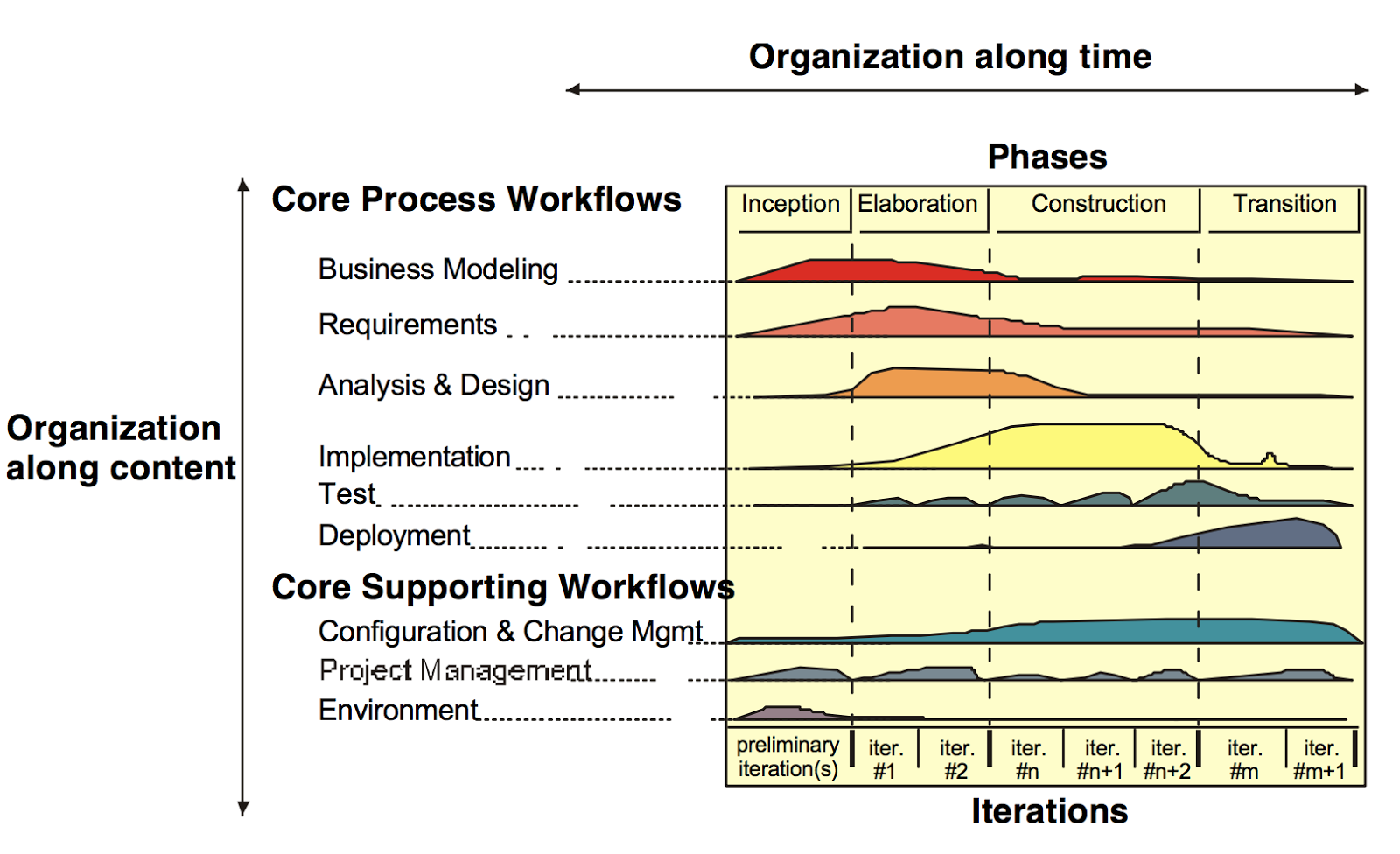
Develop Software Iteratively Given today’s sophisticated software systems, it is not possible to sequentially first define the entire problem, design the entire solution, build the software and then test the product at the end. An iterative approach is required that allows an increasing understanding of the problem through successive refinements, and to incrementally grow an effective solution over multiple iterations. The Rational Unified Process supports an iterative approach to development that addresses the highest risk items at every stage in the lifecycle, significantly reducing a project’s risk profile. This iterative approach helps you attack risk through demonstrable progressfrequent, executable releases that enable continuous end user involvement and feedback. Because each iteration ends with an executable release, the development team stays focused on producing results, and frequent status checks help ensure that the project stays on schedule. An iterative approach also makes it easier to accommodate tactical changes in requirements, features or schedule.
Manage Requirements The Rational Unified Process describes how to elicit, organize, and document required functionality and constraints; track and document tradeoffs and decisions; and easily capture and communicate business requirements. The notions of use case and scenarios proscribed in the process has proven to be an excellent way to capture functional requirements and to ensure that these drive the design, implementation and testing of software, making it more likely that the final system fulfills the end user needs. They provide coherent and traceable threads through both the development and the delivered system.
Use Component-based Architectures The process focuses on early development and baselining of a robust executable architecture, prior to committing resources for full-scale development. It describes how to design a resilient architecture that is flexible, accommodates change, is intuitively understandable, and promotes more effective software reuse. The Rational Unified Process supports component-based software development. Components are non-trivial modules, subsystems that fulfill a clear function. The Rational Unified Process provides a systematic approach to defining an architecture using new and existing components. These are assembled in a well-defined architecture, either ad hoc, or in a component infrastructure such as the Internet, CORBA, and COM, for which an industry of reusable components is emerging.
Visually Model Software The process shows you how to visually model software to capture the structure and behavior of architectures and components. This allows you to hide the details and write code using “graphical building blocks.” Visual abstractions help you communicate different aspects of your software; see how the elements of the system fit together; make sure that the building blocks are consistent with your code; maintain consistency between a design and its implementation; and promote unambiguous communication. The industry-standard Unified Modeling Language (UML), created by Rational Software, is the foundation for successful visual modeling.
Verify Software Quality Poor application performance and poor reliability are common factors which dramatically inhibit the acceptability of today’s software applications. Hence, quality should be reviewed with respect to the requirements based on reliability, functionality, application performance and system performance. The Rational Unified Process assists you in the planning, design, implementation, execution, and evaluation of these test types. Quality assessment is built into the process, in all activities, involving all participants, using objective measurements and criteria, and not treated as an afterthought or a separate activity performed by a separate group.
Control Changes to Software The ability to manage changemaking certain that each change is acceptable, and being able to track changesis essential in an environment in which change is inevitable. The process describes how to control, track and monitor changes to enable successful iterative development. It also guides you in how to establish secure workspaces for each developer by providing isolation from changes made in other workspaces and by controlling changes of all software artifacts (e.g., models, code, documents, etc.). And it brings a team together to work as a single unit by describing how to automate integration and build management.


Monday, July 24, 2017


Friday, July 14, 2017

Wednesday, July 12, 2017
General Approach to Solving a Classification Problem
A classification technique (or classifier) is a systematic approach to building
classification models from an input data set. Examples include decision tree
classifiers, rule-based classifiers, neural networks, support vector machines,
and na ̈ıve Bayes classifiers. Each technique employs a learning algorithm
to identify a model that best fits the relationship between the attribute set and
class label of the input data. The model generated by a learning algorithm
should both fit the input data well and correctly predict the class labels of
records it has never seen before. Therefore, a key objective of the learning
algorithm is to build models with good generalization capability; i.e., models
that accurately predict the class labels of previously unknown records.
Monday, July 10, 2017

Tuesday, July 04, 2017
Classification

Classifying an unlabeled vertebrate. The dashed lines represent the outcomes of applying various attribute test conditions on the unlabeled vertebrate. The vertebrate is eventually assigned to the Non-mammal class.
Monday, July 03, 2017
Training and test error rates

Notice that the training and test error rates of the model are large when the
size of the tree is very small. This situation is known as model underfitting.
Underfitting occurs because the model has yet to learn the true structure of
the data. As a result, it performs poorly on both the training and the test
sets. As the number of nodes in the decision tree increases, the tree will have
fewer training and test errors. However, once the tree becomes too large, its
test error rate begins to increase even though its training error rate continues
to decrease. This phenomenon is known as model overfitting.
Tuesday, June 27, 2017
The input data for a classification task
The input data for a classification task is a collection of records. Each record, also known as an instance or example, is characterized by a tuple (x, y), where x is the attribute set and y is a special attribute, designated as the class label (also known as category or target attribute).
Monday, June 26, 2017
Characteristics of Decision Tree Induction
- Decision tree induction is a nonparametric approach for building classification models. In other words, it does not require any prior assumptions regarding the type of probability distributions satisfied by the class and other attributes.
- Finding an optimal decision tree is an NP-complete problem. Many decision tree algorithms employ a heuristic-based approach to guide their search in the vast hypothesis space.
- Techniques developed for constructing decision trees are computationally inexpensive, making it possible to quickly construct models even when the training set size is very large. Furthermore, once a decision tree has been built, classifying a test record is extremely fast, with a worst-case complexity of O(w), where w is the maximum depth of the tree.
- Decision trees, especially smaller-sized trees, are relatively easy to interpret. The accuracies of the trees are also comparable to other classification techniques for many simple data sets.
- Decision trees provide an expressive representation for learning discrete-valued functions. However, they do not generalize well to certain types of Boolean problems. One notable example is the parity function, whose value is 0 (1) when there is an odd (even) number of Boolean attributes with the value T rue. Accurate modeling of such a function requires a full decision tree with 2d nodes, where d is the number of Boolean attributes.
- Decision tree algorithms are quite robust to the presence of noise, especially when methods for avoiding overfitting are employed.
- The presence of redundant attributes does not adversely affect the accuracy of decision trees. An attribute is redundant if it is strongly correlated with another attribute in the data. One of the two redundant attributes will not be used for splitting once the other attribute has been chosen. However, if the data set contains many irrelevant attributes, i.e., attributes that are not useful for the classification task, then some of the irrelevant attributes may be accidently chosen during the tree-growing process, which results in a decision tree that is larger than necessary. Feature selection techniques can help to improve the accuracy of deci- sion trees by eliminating the irrelevant attributes during preprocessing.
- Since most decision tree algorithms employ a top-down, recursive partitioning approach, the number of records becomes smaller as we traverse down the tree. At the leaf nodes, the number of records may be too small to make a statistically significant decision about the class representation of the nodes. This is known as the data fragmentation problem. One possible solution is to disallow further splitting when the number of records falls below a certain threshold.
- A subtree can be replicated multiple times in a decision tree. This makes the decision tree more complex than necessary and perhaps more difficult to interpret. Such a situation can arise from decision tree implementations that rely on a single attribute test condition at each internal node. Since most of the decision tree algorithms use a divide-and-conquer partitioning strategy, the same test condition can be applied to different parts of the attribute space, thus leading to the subtree replication problem.
- The test conditions described so far involve using only a single attribute at a time. As a consequence, the tree-growing procedure can be viewed as the process of partitioning the attribute space into disjoint regions until each region contains records of the same class. The border between two neighboring regions of different classes is known as a decision boundary. Since the test condition involves only a single attribute, the decision boundaries are rectilinear; i.e., parallel to the “coordinate axes.” This limits the expressiveness of the decision tree representation for modeling complex relationships among continuous attributes.
Sunday, June 25, 2017


Thursday, June 22, 2017
The Success of Decision Tree
The success of decision trees is explained by several factors that make them quite attractive in practice:
- Decision trees are non-parametric. They can model arbitrarily complex relations between inputs and outputs, without any a priori assumption;
- Decision trees handle heterogeneous data (ordered or categorical variables, or a mix of both);
- Decision trees intrinsically implement feature selection, making them robust to irrelevant or noisy variables (at least to some extent);
- Decision trees are robust to outliers or errors in labels;
- Decision trees are easily interpretable, even for non-statistically oriented users.
Wednesday, June 21, 2017
A Gentle Introduction to Random Forests
The random forest (Breiman, 2001) is an ensemble approach that can also be thought of as a form of nearest neighbor predictor. Ensembles are a divide-and-conquer approach used to improve performance. The main principle behind ensemble methods is that a group of “weak learners” can come together to form a “strong learner”. The figure below (taken from here) provides an example. Each classifier, individually, is a “weak learner,” while all the classifiers taken together are a “strong learner”.

Friday, June 16, 2017

Thursday, June 15, 2017
Tuesday, June 13, 2017

Subscribe to:
Posts (Atom)