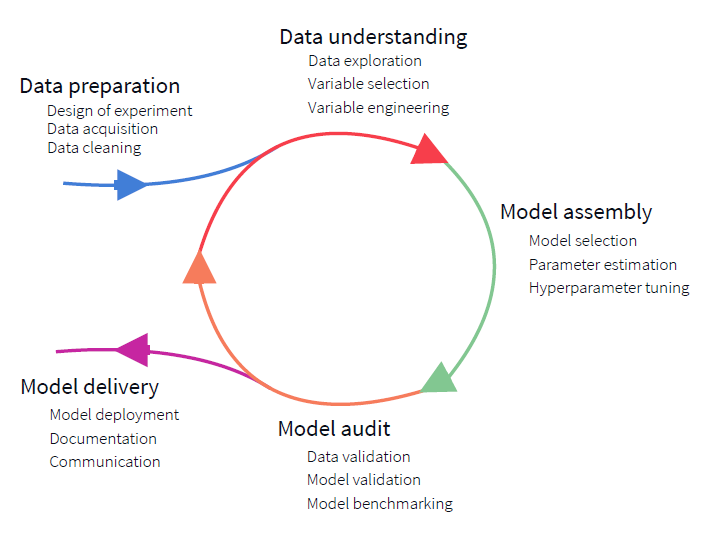
A typical plot diagram for an action movie can be similar to a the narrative structure of a scientific presentation. Just as a protagonist overcomes obstacles through a series of action scenes, a scientist pursues scientific objectives through a series of experiments to reach a goal. As a scientist comes closer and closer to reaching a goal, curiosity comes to a maximal point, the initial scientific question is answered, and the presentation reaches a sense of resolution.
The Zen of Python—a collection of principles that summarize the core philosophy of the language—has crystal-clear points like these:
If the implementation is easy to explain, it may be a good idea.
Data integrity refers to the physical characteristics of collected data that determine the reliability of the information. Data integrity is based on parameters such as completeness, uniqueness, timeliness, accuracy, and consistency.
Completeness
Data completeness refers to collecting all items necessary to the full description of the states of a considered object or process. A data item is considered complete if its digital description contains all attributes that are strictly required for human or machine comprehension. In other words, it may be acceptable to have missing pieces in the expected records (i.e., no contact information) as long as the remaining data is comprehensive enough for the domain.
For example, when a sensor (e.g., an IoT sensor) is involved, you might want it to sample data at a frequency of 10 minutes or even less if required or appropriate for the scenario. At the same time, you might want to be sure that the timeline is continuous with no gaps in between. If you plan to use that data to predict possible hardware failures, then you need be sure you can keep an eye close enough to the target event and not miss anything along the way.
Completeness results from having no gaps in the data from what was supposed to be collected and what is actually collected. In automatic data collection (i.e., IoT sensors), this aspect is also related to physical connectivity and data availability.
Uniqueness
When large chunks of data are collected and sampled for further use, there’s the concrete risk that some data items are duplicated. Depending on the business requirements, duplicates may or may not be an issue. Poor data uniqueness is an issue if, for example, it could lead to skewed results and inaccuracies.
Uniqueness is fairly easy to define mathematically. It is 100 percent if there are no duplicates. The definition of duplicates, however, depends on the context. For example, two records about Joseph Doe and Joe Doe are apparently unique but may refer to the same individual and then be duplicates that must be cleaned.
Timeliness
Data timeliness refers to the distribution of data records within an acceptable time frame. The definition of an acceptable time frame is also context-specific. It refers to the duration of the time frame and the appropriate timeline.
In predictive maintenance, for example, the timeline varies depending on the industry. Usually, a 10-minute timeline is more than acceptable but not for reliable fault predictions in wind turbines. In this case, a 5-minute interval is debated, and some experts suggest an even shorter rate of data collection.
Duration is the overall time interval for which data collection should occur to ensure reliable analysis of data and satisfactory results. In predictive maintenance, an acceptable duration is on the order of two years’ worth of data.
Accuracy
Data accuracy measures the degree to which the record correctly describes the observed real-world item. Accuracy is primarily about the correctness of the data acquired. The business requirements set the specifications of what would be a valid range of values for any expected data item.
When inaccuracies are detected, some policies should be applied to minimize the impact on decisions. Common practices are to replace out-of-range values with a default value or with the arithmetic mean of values detected in a realistic interval.
Consistency
Data consistency measures the difference between the values reported by data items that represent the same object. An example of inconsistency is a negative value of output when no other value reports failures of any kind. Definitions of data consistency are, however, also highly influenced by business requirements.